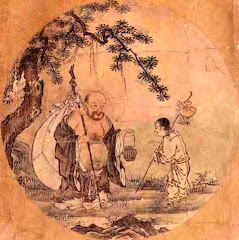
All writing in this blog are from the Masters who returned to THIS (this moment) after crossing THAT (enlightenment). Putting the names & images of the masters will change your perception about the content. That is against the teaching of the Masters. Unless all these images are dissolved, you cannot see yourself.
Millions of fingers can point to the same moon. Fingers are bound to be different -- but the moon is the same. By clinging to the fingers you will not see the moon. Forget the finger and look at where it is pointing. It is the very essence of all the teachings of all the buddhas of all the ages -- past, present, and future too.
The words of a Buddha may not be able to communicate the truth, but they can communicate the music, the music that exists in one who is enlightened.

Wednesday, May 13, 2009

Just the right state of your consciousness and everything starts happening...


A very fundamental law of life is that if you become afraid, you give energy to the other to make you more afraid. The very idea of fear in you creates the opposite idea in the other.
Each thought has a negative and positive polarity just like electricity. If you have the negative pole, on the other side a positive pole is created. It is automatic. If you are afraid, the other immediately feels a desire arising in him to oppress you, to torture you. If you are not afraid, the desire in the other simply disappears And it is not only so with man, it is so even with wolves. With animals it is also the same.

If you can remain in the right state -- that is, undistracted, silent, just a witness to everything, to whatsoever is happening, with no idea arising in you -- then no idea will arise in others around you.

There is an old Indian story.
In the Hindu heaven, there is a tree called 'Kalptaru.' It means the wish-fulfilling tree. By accident a traveler arrived there and he was so tired that he sat under the tree. And he was hungry so he thought, 'If somebody was here, I would ask for food. But there seems to be nobody.'

The moment the idea of food appeared in his mind, food suddenly appeared and he was so hungry that he didn't bother to think about it. He ate it. Then he started feeling sleepy, and he thought, 'If there was a bed here....' And the bed appeared.

But lying on the bed the thought arose in him, 'What is happening? I don't see anybody here. Food has come, a bed has come -- maybe there are ghosts doing things to me!' Suddenly ghosts appeared..

Then he became afraid and he thought, 'Now they will kill me!' And they killed him!

In life the law is the same: if you think of ghosts, they are bound to appear. Think and you will see. If you think of enemies, you will create them; if you think of friends, they will appear. If you love, love appears all around you; if you hate, hate appears. Whatsoever you go on thinking is being fulfilled by a certain law.

If you don't think anything, then nothing happens to you.

The Master simply sat there in the graveyard. The wolves came, but finding nobody there they sniffed. They must have sniffed to see whether this man was thinking or not. They circled around. They watched. But there was nobody, just emptiness. What to do with emptiness?

This emptiness, this silence, this bliss, cannot be destroyed. Not even wolves are that bad. They felt the sacredness of this emptiness and they disappeared.

The villagers thought that this man had done some secret rites, but the Master said, 'I have not done anything, nor could I have done so. I simply sat there and everything changed.'

This anecdote is a parable. If you sit in this world, silently, if you live silently, as an alive nothingness, the world will become a paradise. The wolves will disappear. There is no need to do anything else. Just the right state of your consciousness and everything is done.

There are two laws. One law is of the mind. With the law of the mind you go on creating hell around you; friends become foes, lovers prove enemies, flowers become thorns. Life becomes a burden. One simply suffers life. With the law of mind, you live in hell wherever you live. If you slip out of the mind, you have slipped out of that law, and suddenly you live in a totally different world. That different world is nirvana. That different world is God.

Then without doing, everything starts happening.

Tuesday, May 12, 2009

The function of the parents is not how to help the children grow...


The moment you start thinking how to help children to grow without any competitive spirit you are already on the wrong track, because whatever you are going to do is going to give the children a certain program. It may be different from the one that you received, but you are conditioning the children -- with all the best intentions in the world.

The trees go on growing without anybody teaching them how to grow. The animals, the birds, the whole existence, needs no programming. The very idea of programming is basically creating slavery -- and man has been creating slaves for thousands of years in different names. When people become fed up with one name, another name immediately replaces it. A few modified programs, a few changes here and there in the conditioning, but the fundamental thing remains the same -- that the parents, the older generation, want their children to be in a certain way.

According to me, the function of the parents is not how to help the children grow -- they will grow without you. Your function is to support, to nourish, to help what is already growing. Don't give directions and don't give ideals. Don't tell them what is right and what is wrong: let them find it by their own experience.

Only one thing you can do, and that is share your own life. Tell them that you have been conditioned by your parents, that you have lived within certain limits, according to certain ideals, and because of these limits and ideals you have missed life completely, and you don't want to destroy your children's life. You want them to be totally free -- free of you, because to them you represent the whole past.

It needs guts and it needs immense love in a father, in a mother, to tell the children, "You need to be free of us. Don't obey us -- depend on your own intelligence. Even if you go astray it is far better than to remain a slave and always remain right. It is better to commit mistakes on your own and learn from them, rather than follow somebody else and not commit mistakes. But then you are never going to learn anything except following -- and that is poison, pure poison."

It is very easy if you love. Don't ask "how", because "how" means you are asking for a method, a methodology, a technique -- and love is not a technique.
Love your children, enjoy their freedom. Let them commit mistakes, help them to see where they have committed a mistake. Tell them, "To commit mistakes is not wrong -- commit as many mistakes as possible, because that is the way you will be learning more. But don't commit the same mistake again and again, because that makes you stupid."

This should be the principle: children should be helped to listen to their bodies, to listen to their own needs. The basic thing for parents is to guard the children from falling into a ditch. The function of their discipline is negative.

Remember the word "negative"... no positive programming but only a negative guarding -- because children are children, and they can get into something which will harm them, cripple them. Then too don't order them not to go, but explain to them. Don't make it a point of obedience; still let them choose. You simply explain the whole situation.

Children are very receptive, and if you are respectful towards them they are ready to listen, ready to understand; then leave them with their understanding. And it is a question only of a few years in the beginning; soon they will be getting settled in their intelligence, and your guarding will not be needed at all. Soon they will be able to move on their own.

I can understand the fear of the parents that the children may go in a direction which they don't like -- but that is your problem. Your children are not born for your likings and your dislikings. They have to live their life, and you should rejoice that they are living their life -- whatever it is. They may become a poor musician....

The function of a father or a mother is great, because they are bringing a new guest into the world -- who knows nothing, but who brings some potential in him. And unless his potential grows, he will remain unhappy.

No parents like to think of their children remaining unhappy; they want them to be happy. It is just that their thinking is wrong. They think if they become doctors, if they become professors, engineers, scientists, then they will be happy. They don't know! They can only be happy if they become what they have come to become. They can only become the seed that they are carrying within themselves.

So help in every possible way to give freedom, to give opportunities. Ordinarily, if a child asks a mother anything, without even listening to the child, to what he is asking, the mother simply says no. "No" is an authoritative word; "yes" is not. So neither father nor mother or anybody else who is in authority wants to say yes -- to any ordinary thing.

The child wants to play outside the house: "No!" The child wants to go out while it is raining and wants to dance in the rain: "No! You will get a cold." A cold is not a cancer, but a child who has been prevented from dancing in the rain, and has never been able again to dance, has missed something great, something really beautiful. A cold would have been worthwhile -- and it is not that he will necessarily have a cold. In fact the more you protect him, the more he becomes vulnerable. The more you allow him, the more he becomes immune.

Parents have to learn to say yes. In ninety-nine times when they ordinarily say no, it is for no other reason than simply to show authority. Everybody cannot become the president of the country, cannot have authority over millions of people. But everybody can become a husband, can have authority over his wife; every wife can become a mother, can have authority over the child; every child can have a teddy bear, and have authority over the teddy bear... kick him from this corner to the other corner, give him good slaps, slaps that he really wanted to give to the mother or to father. And the poor teddy bear has nobody below him.

This is an authoritarian society.

What I am saying is in creating children who have freedom, who have heard "yes" and have rarely heard "no", the authoritarian society will disappear. We will have a more human society.

So it is not only a question of the children. Those children are going to become tomorrow's society: the child is the father of man.

Monday, May 11, 2009

Wealth, Knowledge, Information - you think that you are growing...


A certain group of scientists thinks that man is a regression, not an evolvement. It may be so because in life you can never be static. If you are not evolving, you will regress. There is no static moment in life; you cannot remain at one point. You cannot say, "I am not growing, so I will remain whatsoever I am; I will maintain the status quo." You cannot maintain it! Either you go further or you fall down -- back. A certain group of scientists thinks that man is regressing day by day, that there is an "infantilization". Man is behaving more like a child than like an adult -- man everywhere on the earth.

If we look, many things become clear and obvious. One thing: in the past, it was always the old man, the evolved man, who was most predominant in society, but our society is the only society in the world's history where children have become predominant. They dominate everything -- every trend, every fashion, everything. They are the models. Whatsoever they do becomes religion, whatsoever they do becomes politics, whatsoever they do sets a trend all over the world.

If we go back, a thirty-year-old person was behaving in a mature way. Now that is not the case. Even a thirty-year-old person is behaving in infantile ways, juvenile ways -- with the same tantrums. the same childish attitudes. What are these childish attitudes? A child thinks that he is the center of the world and that his every wish is to be fulfilled immediately. It is fulfilled. When he is hungry milk is given, when he weeps everyone pays attention. The whole family is centered around him.

Children become dictators. They know how to dictate the whole family. A very small child dictates the whole family. The father persuades him, the mother bribes him. Even when guests come into the home, he will dictate everything! A child thinks that he is the center of the world. He is to be supported, helped by everyone, without any cost. He is not to give love: he is only to demand. Of course, we cannot expect from a child that he should love. He demands and demands everything, and if the demand is not fulfilled he gets violent, angry. Then he is against the whole world; he will smash things.

Now this has happened with everyone. This was always so with children, but now this is with everyone. Our so-called revolutions are nothing else but childish efforts. Our so-called rebellions are nothing else but everyone thinking himself to be at the center. His every desire should be fulfilled immediately; and if it is not fulfilled, then he is going to destroy the whole world.

Students revolt in universities all over the world. They just show immature, juvenile minds. What does it mean, students throwing stones at university windows, setting fire to buildings, destroying? What does it mean? They have no sense of maturity at all. And if you begin to think about it, it is not only students and children, boys and girls: if you look at our modern man -- even at a father or a mother -- you will see that they are behaving childishly. If you look at our politicians, they are just behaving childishly with no maturity at all.

What has happened? Really, man's growth has stopped: evolutionary growth has stopped. And now we have just a substitute for this growth -- scientific accumulation. Man has stopped; things grow. Your house goes on becoming bigger and bigger, and you remain the same. Your wealth grows, and because of this growth you feel that you are growing. Your knowledge grows, your information grows, and because of this you think that you are growing.

Of course, obviously, a Buddha knows less than you, but that doesn't mean that you are more grown-up. A Jesus knows less than you. He knows less than any Catholic priest because he was never trained, never educated. He was just a carpenter's son -- uneducated, with no information of the world; but still, you are not more evolved than him. A Mohammed is just illiterate, a Kabir is just a nobody -- but they are more evolved. But then that evolution is something else: an evolution of consciousness, not just of things.

You can substitute having for being. Being is a different dimension of growth -- a vertical one; having is horizontal. Things go on and on, and you have so many things -- so much information, so much knowledge, so much wealth, so many degrees, so many honours. But this is accumulation: it is horizontal. There is no upward thrust. You remain the same. And you cannot really remain the same, because if you are not growing you begin to behave childishly: you regress. This is one of the greatest problems humanity is encountering today.

Thursday, April 30, 2009

The ego is something that everybody is aware of except yourself...


An egotistical lover met a girl in a drugstore and asked her 'How would you like to sleep with me tonight, baby?' The giri, insulted and angry, used her knowledge of judo and swung him out of the door. Jolted and jilted, the egotistical lover returned. 'But baby,' he said, 'You haven't answered my question!'

That's what ego is -- the greatest stupidity. You can't see it because you are it. You can always see it in others, you cannot see it in yourself.

A Jew suddenly became very rich and he wanted to show it off to everybody. So he and his wife went to the costliest restaurant dressed in the costliest dresses. The wife was wearing diamonds and emeralds and all that money could purchase -- and they had really become very rich. She was looking very ugly with all those diamonds and emeralds because she had no taste. You can become rich suddenly but you cannot gain taste suddenly. You can become rich suddenly but you cannot become cultured suddenly.

And sometimes, when you suddenly become rich, all your ugliness comes to the surface. You purchase all that ugliness with your richness -- you can afford it now. Up to now it had been hidden but now it comes to the surface.

They sat down in the restaurant and looked at the menu. But as the menu was in French they could not read it -- they did not know anything about French and they did not want to admit it to the waiter. So the wife asked, 'What are you going to order now?' He told her not to be worried and said to the waiter, 'Bring me one hundred dollars' worth of salami sandwiches -- one hundred dollars' worth.'

The ego is just absurd. Asking for one hundred dollars' worth of salami sandwiches!
The waiter could not believe it. He said, 'You are both going to eat them all?'

It is difficult to look at your own ego. The ego is something that everybody is aware of except yourself. Whenever others say something about you, ponder over it, meditate over it. There is every possibility that they will be right. When others say something about your ego, don't deny it, don't reject it. There IS every possibility that they will be right. There is a ninety-nine per cent possibility that they are right -- because others can very easily see your ego even if you cannot. And you can see other egos very easily; it is there just exactly on the tip of their noses. In everything they do -- walking, talking sitting, listening -- it is there. It is so apparent, so obvious to everybody -- except to the person himself. He hides behind it.

The actors were out of work when they met in Lindy's one day. 'Say, I got an idea, ' said one. 'Why don't we team up? Do an act together.'
'Sounds good,' said the other. 'What kind of an act you got in mind?'
'Well, I come out and sing. The curtain comes down. Then it goes up and I come out and dance. Then it comes down. Then it goes up again and I come out and juggle. Then.... '
'Hey, where do I come in?'
'The curtain don't go up and down by itself!'

That's what ego is. You are the emperor and everybody IS a servant. You are the end and everybody is a means This is the basic ingredient of the ego, the very centre -- that you are the centre of the whole existence and everybody is here to serve you, to be used by you. If you are using people you are an egoist. If you think of yourself as the centre and everybody else as your periphery then you are an egoist.

If you think that everybody is an end unto himself, then the ego starts disappearing. If you don't put yourself higher than others or lower than others then the ego disappears. Remember, you know that to put yourself higher than others is to be egoistical but I am saying that to put yourself lower than others is also egoistical. It is ego standing on its head but it is ego all the same. So don't put anybody higher than you and don't put anybody lower than you. We are one. We are one existence. Nobody is lower, nobody is higher. Nobody is superior, nobody is inferior. There are not two gods so how can there be inferiority or superiority? It is one unity. Ego makes you feel separate; non-ego joins you to existence. To feel one with the cosmos is to get out of the ego; to feel separate is to be with the ego.

Ego is what Tao is not; and Tao is what ego is not. If you are in the ego you will never taste Tao, if you want to taste Tao you will have to drop the ego. Dropping it, you come home; dropping it, the benediction is there.

Sunday, March 29, 2009

SAT-CHIT-ANAND - truth, consciousness, bliss...


In the East we have always defined the ultimate truth as SAT-CHIT-ANAND. SAT means truth, CHIT means consciousness, ANAND means bliss. They are all three faces of the same reality. This is the true trinity -- not God the Father, and the Son, Jesus Christ, and the Holy Ghost; that is not the true trinity. The true trinity is truth, consciousness, bliss. And they are not separate phenomena, but one energy expressing in three ways, one energy having three faces. Hence in the East we say God is TRIMURTI -- God has three faces. These are the real faces, not Brahma, Vishnu, Mahesh. Those are for the children -- spiritually, metaphysically, for the immature. Brahma, Vishnu, Mahesh: those names are for the beginners.

Following four words will have to be understood, pondered over. The first is pleasure, the second, happiness; the third is joy, and the fourth is bliss.

Pleasure is physical, physiological. Pleasure is the most superficial thing in life; it is titillation. It can be sexual, it can be of other senses, it can become an obsession with food, but it is rooted in the body. The body is your periphery, your circumference; it is not your center. And to live on the circumference is to live on the mercy of all kinds of things that go on happening around you. The man who seeks pleasure remains at the mercy of accidents.

It is like the waves in the ocean; they are at the mercy of the winds. When strong winds come, they are there; when winds disappear, they disappear. They don't have an independent existence; they are dependent, and anything that is dependent on the other brings bondage.
Pleasure is dependent on the other. If you love a woman, if that is your pleasure, then that woman becomes your master. If you love a man, if that is your pleasure and you feel unhappy, in despair, sad, without him, then you have created a bondage for yourself. You have created a prison, you are no more in freedom.

If you are a seeker after money and power, then you will be dependent on money and power. The man who goes on accumulating money, if it is his pleasure to have more and more money, will become more and more miserable -- because the more he has, the more he wants, and the more he has, the more he is afraid to lose it. A double-edged sword: the more he wants... the first edge of the sword. Hence he becomes more and more miserable.

The more you demand, desire, the more you feel yourself lacking something, the more hollow, empty, you appear to yourself. On the other hand -- the other edge of the sword -- is that the more you have, the more you are afraid it can be taken away; it can be stolen. The bank can go bankrupt, the political situation in the country can change, the country can go communist. There are a thousand and one things upon which your money depends. Your money does not make you a master, it makes you a slave. Pleasure is peripheral; hence it is bound to depend on the outer circumstances. And it is only titillation.

If food is pleasure, what actually is being enjoyed? -- just the taste! For a moment, when the food passes your taste buds on the tongue, you feel a sensation which you interpret as pleasure. It is your interpretation. Today it may look like pleasure and tomorrow it may not look like pleasure. If you go on eating the same food every day your buds on the tongue will become nonresponsive to it. Soon you will be fed up with it -- that's how people become fed up.

One day you are running after a man or a woman and the next day you are trying to find an excuse to get rid of the other. The same person, nothing has changed! What has happened meanwhile? You are bored with the other, because the whole pleasure was in knowing the new. Now the other is no longer new; you are acquainted with the territory of the other. You are acquainted with the body of the other, the curves of the body, the feel of the body. Now the mind is hankering for something new.

The mind is always hankering for something new. That's how mind keeps you always tethered somewhere in the future. It keeps you hoping, but it never delivers the goods -- it cannot. It can only create new hopes, new desires.

Just as leaves grow on the trees, desires and hopes grow in the mind. You wanted a new house and now you have it -- and where is the pleasure? Just for the moment it was there, when you achieved your goal. Once you have achieved your goal, your mind is no longer interested in it; it has already started spinning new webs of desire. It has already started thinking of other, bigger houses. And this is so about everything.

The second word to be understood is happiness. Happiness is psychological, pleasure is physiological. Happiness is a little better, a little more refined, a little higher, but not very much different from pleasure. You can say that pleasure is a lower kind of happiness and happiness is a little higher kind of pleasure -- two sides of the same coin. Pleasure is a little primitive, animal; happiness is a little more cultured, a little more human -- but it is the same game played in the world of the mind. You are not so much concerned with physiological sensations; you are much more concerned with psychological sensations. But basically they are not different.

The third is joy; joy is spiritual. It is different, totally different from pleasure, happiness. It has nothing to do with the other; it is inner. It is not dependent on circumstances; it is your own. It is not a titillation produced by things; it is a state of peace, of silence, a meditative state. It is spiritual.

There is still one thing that goes beyond joy. Buddha calls it bliss. Bliss is total. It is neither physiological nor psychological nor spiritual. It knows no division, it is indivisible.

Pleasure is momentary, of time, for the time being; bliss is nontemporal, timeless. Pleasure begins and ends; bliss abides forever. Pleasure comes and goes; bliss never comes, never goes -- it is already there in the innermost core of your being. Pleasure has to be snatched away from the other; you become either a beggar or a thief. Bliss makes you a master. Bliss is not something that you invent but something that you discover. Bliss is your innermost nature. It has been there since the very beginning, you just have not looked at it, you have taken it for granted. You don't look inwards.

This is the only misery of man: that he goes on looking outwards, seeking and searching. And you cannot find it in the outside because it is not there.

Thursday, March 26, 2009

Solitariness has a healing effect, it is a healing force...


In the East, particularly in Japan -- because of zen -- a totally different treatment has existed for at least one thousand years. In zen monasteries... these are not in any way hospitals, not meant for ill people, but in a village, if a zen monastery exists, it is the only place; if someone goes mad or neurotic, where to go? In the East always they bring the neurotic people to the master because if he can treat normal people, why not neurotics? The difference is only of degree.

So they will bring the neurotic people to the zen monastery, to the master, and they will say, 'What to do? You take charge of him.' And he will take charge.

And the treatment is really unbelievable! The treatment is -- no treatment at all. The man has to be given a solitary cell somewhere at the back of the monastery, in a corner; the neurotic has to live there. He will be given food, every facility -- that's all. And he has to live with himself. Within three weeks, only three weeks, with no treatment, the neurosis disappears.

Now many Western psychiatrists are studying this as a miracle. This is not a miracle. This is simply giving the man a little space to sort it out, that's all! Because he was normal a few days before, he can be normal again. Something has become too heavy on him and he needs space, that's all. And they will not pay him much attention, because if you pay a neurotic person much attention, as it is being paid in the West, he is never going to be back to normal again because nobody paid him so much attention before. He is never going to be back the same, because then nobody bothered about him, and now great psychoanalysts are bothering -- great doctors, names, world-famous names, and they talk to him or her: the patient lying on a couch resting, and a great name just sitting behind, and whatsoever he or she says is listened to carefully, every word. So much attention! The neurosis becomes an investment, because people NEED attention.

A few people start behaving foolishly because then the society gives them attention. In every old country, in every village, you will find a village fool -- and he is not a mediocre man, he is very intelligent. Fools are almost always intelligent, but they have learned a trick: people pay them attention, they feed them, everybody knows them, they are already famous without holding any post -- the whole village looks after them. Wherever they pass, they are like great leaders, a crowd follows them: children jumping and throwing things at them -- and they enjoy it! They are great ones in the town, and they know that this being a fool is an investment, a good one! And the village takes care of them: they are well fed, well clothed -- they have learned the trick. No need to work, no need to do anything -- just be a fool and it is enough!

If a neurotic person... and remember ego IS neurosis and ego needs attention; pay it attention, and ego feels good. Many people have murdered simply to get the attention of the newspapers, because only when they murder can they be covered by headlines. They become suddenly very, very important -- their pictures are given, their names, their biographies are covered: suddenly they are not nobodies, they have become somebodies.

Neurosis is a deep hankering after attention, and if you give it attention, you feed it -- that's why psychoanalysis has been a complete failure.

In zen monasteries they treat a person within three weeks: in Freudian psychoanalysis they cannot treat him in thirty years, because they miss the very point. But in zen monasteries no attention is given to the neurotic person, nobody thinks that he is somebody important -- they simply leave him alone, that is the only treatment. He has to sort out his own things; nobody bothers. Within three weeks he comes out absolutely normal.

Solitariness has a healing effect, it is a healing force. Whenever you feel that you are getting messed up, don't try to solve it there. Move away from society for a few days, for at least three weeks, and just remain silent, just watching yourself, feeling yourself, just being with yourself, and you will have a tremendous force available which heals. Hence, in the East, many people have moved to the mountains, to the forests, somewhere alone, somewhere where there is nobody else to be bothered with. Only oneself... so one can feel oneself directly, and you can see what is happening within.

Nobody is responsible for you except yourself, remember. If you are mad you are mad -- you have to sort it out: it is your deed! This is what Hindus say: your karma. The meaning is very deep. It is not a theory. They say, whatsoever you are it is your own work, so sort it out! Nobody else is responsible for you, only you are responsible.

So go into solitary confinement -- to sort out things, meditate on your own being and your problems. And this is the beauty: even if you can just be quiet, living with yourself for a few days, things settle automatically, because an unsettled state is not natural. An unsettled state is unnatural, you cannot prolong it for long. It needs effort to prolong it. Simply relax and let things be, and watch, and make no effort to change anything, remember; if you try to make any change you will continue the same because the very effort will continue to disturb things.

It is just like sitting by the side of a river: the river flows, the mud settles, the dead leaves go to the sea; by and by the river becomes absolutely clean and pure. You need not go into it to clean it -- if you go, you will muddle it more. Simply watch, and things happen. This is what the theory of karma is: that you have messed yourself up; now move alone.

So you need not throw your problems on others, you need not throw your diseases on others -- you simply move alone; suffer them in silence, watch them. Just sit by the bank of the river of your mind. Things settle! When things settle you have a clarity, a perception. Then move back into the world -- if you feel like it. That too is not a necessity, that too should not be an obsession. Nothing should be an obsession.

Wednesday, March 25, 2009

If you want to live, live now...


I have heard about a German professor. He wanted to have the biggest collection of philosophical, religious, spiritual literature. And he was a very rich man too, so he wandered around the earth collecting all kinds of scriptures. There are three hundred religions in the world, and there are hundreds of philosophies, and each philosophy has hundreds of books in different languages. And he had translators translating them all into German. This was all preparation for when he would start reading.

But by the time he was ninety, he was still collecting books.

Somebody told him, "Now it is time that you should start reading. The preparation has gone on too long, and you have thousands and thousands of books -- we don't think you will be able to read all of them. Your life is just at the very end, maybe a year or two more."
But the man said, "But my collection is not complete yet."

So he started collecting more forcibly, put more men into collection, into translation. Finally he fell sick, and the doctor said, "He is not going to survive more than seven days."

He called all the scholars who were translating his books: "Now stop translating. You just try to find small summaries from every scripture, because I have got only seven days and I want to know what is written in all the scriptures. So just prepare small summaries of all the scriptures."

But the scholars said, "You have collected so many scriptures, even summaries will not be possible. We will try, but in seven days all the summaries will not be ready."

The last day came. He inquired again, "What has happened?"

They said, "We are trying."

He said, "Forget all about it. You do one thing: just make one small note summarizing all the scriptures. Because there is no more time; I feel that I am going. So be fast and be quick."

They said, "How can we be fast and quick? We have to look into scriptures to find the very gist, the very essential center of all of them. It will take a little time."

The whole day passed, and by the evening when they had come to a conclusion, a small summary of a few pages.... They reached; the man was almost drowning. He said, "That many pages won't do. You just make it half a page, just a small summary that can be printed on a postcard. I don't have time for all these pages."

So they rushed back, again they summarized. Now it meant nothing, because all those scriptures, summaries and summaries... and by the time they came back, the man was dead.

His wife said, "It is a very sad thing. You can at least shout loudly in his ear; perhaps he may be able to hear. He is just going down."

The doctor said, "Now it is useless. But you can try, there is no harm in it." So one scholar shouted the summary of all the scriptures. But the man was dead already, and the doctors were saying, "Now he cannot hear."

His whole life went into preparation.

And this is not the story of one strange, weird man. This is the story of all normal people: preparation, preparation, preparation. They forget completely, that... preparation for what?

We are not certain even of the next moment.
Preparation for what?
Either live or prepare.
If you want to live, live now.

Or prepare for tomorrow -- and remember, tomorrow never comes. What comes in place of tomorrow is death. An intelligent person lives his life. He does not bother about preparations, disciplines.